
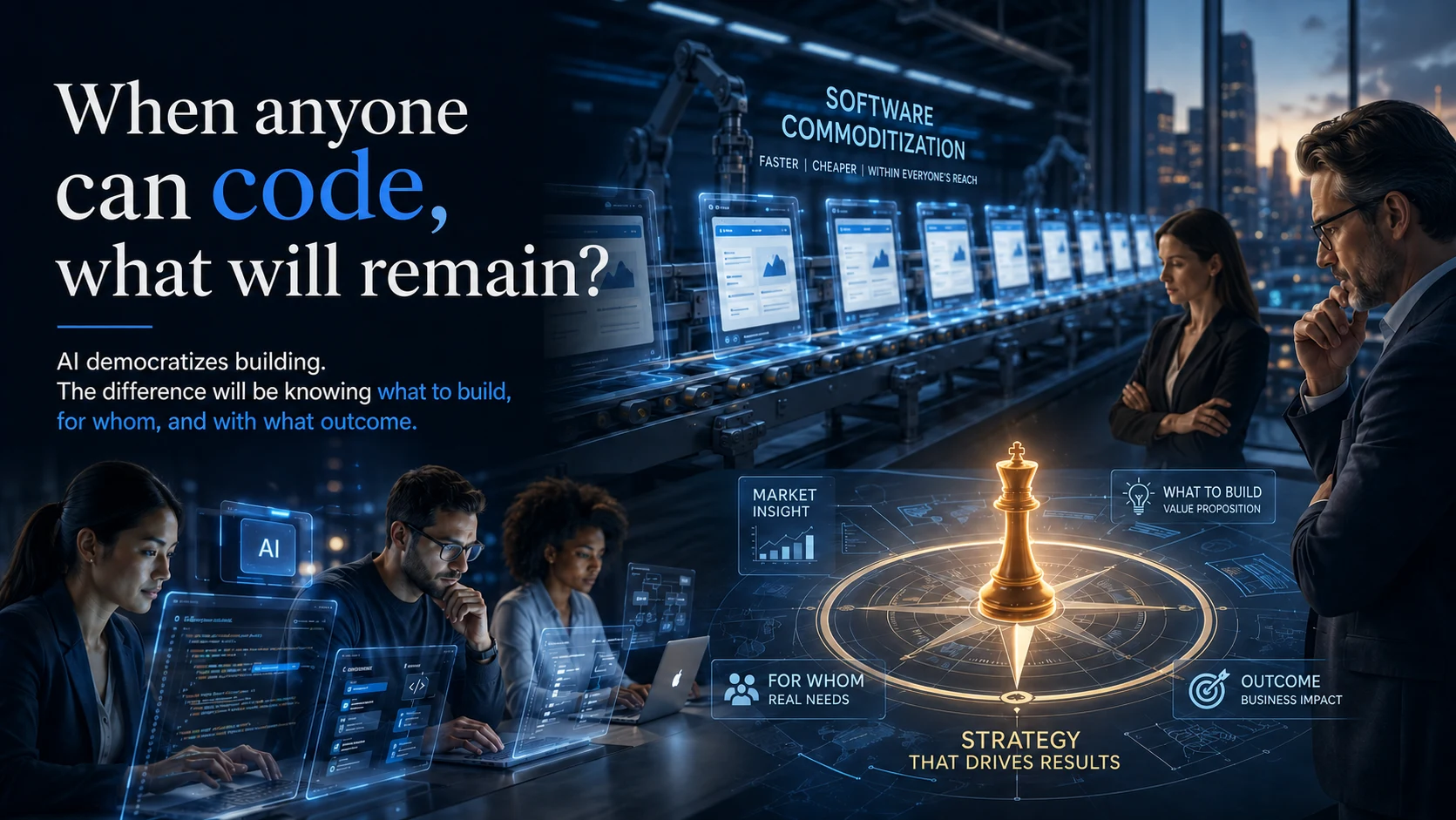
Short answer: when coding is no longer a scarce capability, the advantage will not come from simply building software. It will come from deciding what is worth building, for whom, with which data, through which distribution channels, and toward which measurable business outcome.
Artificial intelligence is closing a gap that seemed enormous for decades.
Software development once required years of study, technical experience, and a substantial learning curve. Today, someone without deep programming expertise can use AI to create an application, connect an API, automate a process, or build a solution that only a few years ago would have required a specialized team.
At the same time, experienced developers have become far more productive.
AI did not eliminate engineering. It dramatically lowered the barrier to building.
And when a capability stops being scarce, the way it creates value begins to change.
We have seen differentiating capabilities become infrastructure before
At the beginning of the twentieth century, manufacturing a car was slow, expensive, and largely artisanal. Ford transformed production with the moving assembly line: according to the company’s own history, the new process introduced in 1913 reduced the time required to assemble a Model T to approximately 90 minutes. Cars could be produced faster, at a lower cost, and for many more people.
The automobile did not lose its value. What stopped being extraordinary was producing it in the old way. Ford’s history of the moving assembly line shows how a production innovation can turn a scarce capability into a widely available one.
Decades later, something similar happened with computers and the Internet.
Those of us who remember the early Internet also remember slow connections, websites that took minutes to load, and computers that represented a significant investment. Owning a computer was a differentiator. Having Internet access was a differentiator. Knowing how to build a website was, too.
Then came mass adoption: more manufacturers, more infrastructure, more speed, more competition, and more knowledge. Owning a computer or having an Internet connection stopped being a competitive advantage on its own. It became infrastructure.
I believe something similar is happening now with artificial intelligence.
Building software will become easier; building it well will remain difficult
For many years, part of a software company’s value came precisely from its ability to develop an ERP, a CRM, an inventory module, an integration, a dashboard, or an internal application. All of these required time, specialized knowledge, and significant budgets.
Those timelines are now shrinking rapidly. The consequence seems inevitable: many software capabilities will begin to become commodities.
That does not mean good software development is easy. Security, architecture, scalability, maintenance, user experience, observability, and integration still demand deep expertise. Generating code is one part of the job; operating a reliable system when users, sensitive data, failures, and changing business requirements appear is something very different.
But the distance between those who could build something and those who could not is narrowing. That creates a dangerous illusion:
“I can create an application; therefore, I have a business.”
Not necessarily. Building has never been the same as creating value.
The important question is no longer what AI can build
I am an entrepreneur. I have built projects, made mistakes, and experienced failures. Much of what a business truly teaches you is not necessarily about technology.
It is about understanding customers, selling, managing costs, leading people, designing processes, controlling risk, and executing. It is about discovering problems that look small from the outside but represent lost money, time, and opportunity inside an organization.
That is why I believe the question in this new stage will no longer be only “What can we build with artificial intelligence?” It will be “What is truly worth building?”
We will probably have millions of applications, agents, automations, and AI-created solutions. That does not mean we will have millions of good businesses.
AI’s blue ocean is not saying “we use AI”
In Blue Ocean Strategy, W. Chan Kim and Renée Mauborgne argue that companies should not limit themselves to competing in existing markets—the red oceans—but should create new market spaces where competition becomes less relevant.
One of their central concepts is value innovation: pursuing differentiation and low cost simultaneously to create a leap in value for both the buyer and the company.
This raises an especially interesting question: what is artificial intelligence’s blue ocean?
I do not believe it is simply developing applications with AI. That will probably become a red ocean very quickly. Nor will it be enough for a company to say that it “has artificial intelligence.” Soon, almost every company will be able to say that.
The real value will probably lie elsewhere:
- understanding an industry deeply;
- recognizing problems that others still cannot see;
- owning relevant data and knowing how to interpret it;
- having access to customers and distribution channels;
- building trust;
- understanding real processes; and
- executing better than everyone else.
Artificial intelligence would not be the value proposition. It would be the multiplier of that value proposition.
Customers do not buy artificial intelligence; they buy outcomes
Customers rarely want AI for its own sake. They want to sell more, reduce costs, eliminate rework, respond faster, make better decisions, reduce risk, save time, or create an advantage they did not have before.
That is why the next competitive advantage may not be knowing how to build. It will be knowing:
- what to build;
- who to build it for;
- why it should exist; and
- which outcome it must produce.
AI is democratizing the tools, but tools do not automatically replace judgment, experience, market knowledge, the ability to sell, or execution.
Perhaps that is where the next gap will appear. First, the advantage was access to technology. Then, it was knowing how to use it. Now, the real advantage may be knowing how to turn it into results.
What will remain difficult to copy?
If almost anyone can soon build almost anything, what will remain scarce?
- Accumulated knowledge of a business?
- Data and feedback loops?
- Distribution and access to customers?
- Trust?
- Experience earned through years of mistakes?
- The ability to execute consistently?
- Or is there a new blue ocean we still cannot see?
I am especially interested in the perspective of entrepreneurs, developers, and people currently building around artificial intelligence.
Because perhaps the greatest mistake of this wave would be falling in love with everything AI can build while forgetting to ask what is truly worth building.
Deja una respuesta