
Organizations today have more communication tools than ever. Email, Slack, Microsoft Teams, Asana, Notion, WhatsApp, project-management platforms and increasingly sophisticated AI tools allow information to move almost instantly.
And yet, communication continues to be one of the biggest operational challenges inside companies.
The Real Problem Is Context
Information can travel in seconds. Understanding does not always travel at the same speed.
A simple example happens every day: an invoice arrives by email.
- Someone receives it and forwards it.
- Another person forwards it again.
- Someone responds with partial information.
- A new person gets copied into the conversation.
What exactly am I supposed to do with this?
The email travelled. The context did not.
From Forwarding Information to Escalating Context
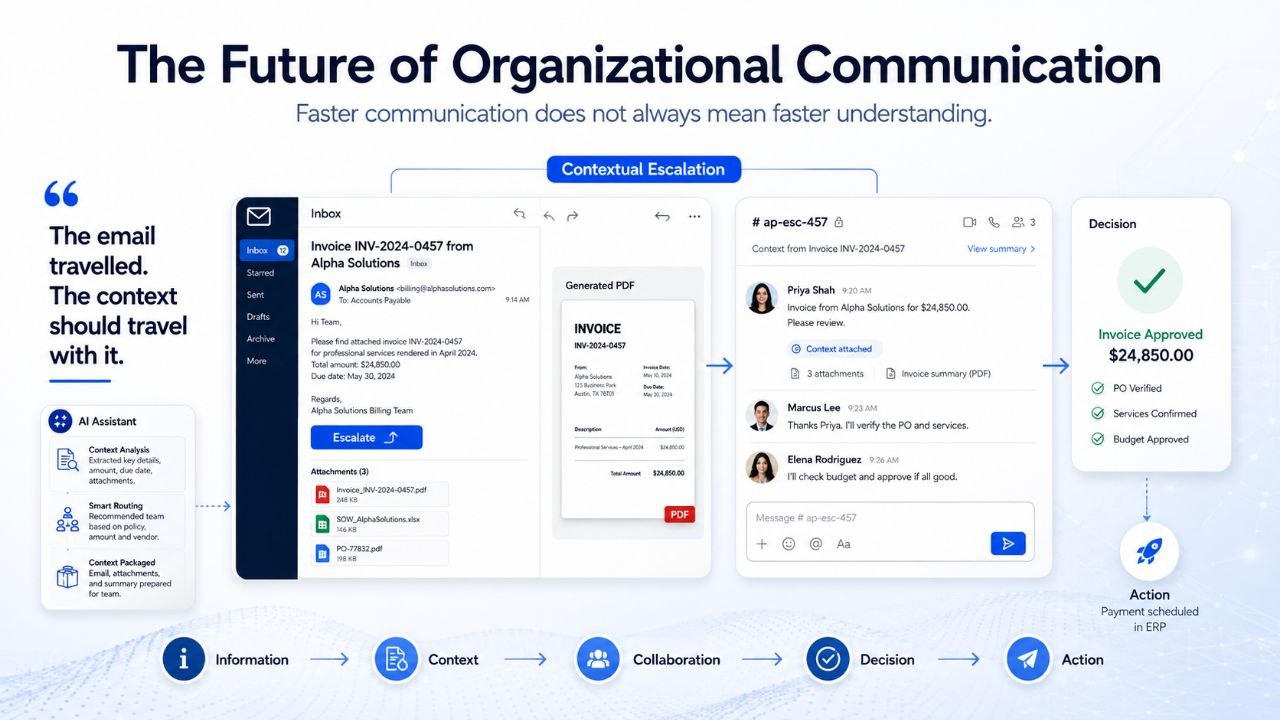
In the company where I work, I wanted to approach this problem differently. We integrated our professional email inboxes directly into our internal application.
Instead of simply recreating a traditional inbox, we introduced a concept that changes the way information moves: Escalate.
When an email requires the participation of other people, I do not need to forward it repeatedly. I select Escalate, choose the people who need to participate, and the system automatically creates a contextual conversation around that email.
Within just a few seconds, the application:
- Creates the internal conversation.
- Includes the relevant people.
- Attaches all documents contained in the email.
- Generates a PDF version of the original message.
- Preserves the information that originated the discussion.
Instead of forwarding an invoice and writing “Please review,” I can ask a precise question:
Has the merchandise associated with this invoice already been delivered, or is delivery still pending?
Operations can respond. Accounting can add information. Purchasing can clarify another point. Someone else can identify an inconsistency. Once enough information exists, the organization can make a decision.
Information → Context → Collaboration → Decision → Action
This is not simply a faster way to send information. It is a different communication model.
Speed Is Not the Same as Efficiency
There is an interesting contradiction in modern communication. We want everything to be faster: messages should arrive immediately, responses should be quick, and decisions should take less time.
Technology has largely solved the first part of that equation. In our case, escalating an email, attaching all its documents and generating a PDF version of the original message can happen within just a few seconds. That speed is valuable.
But speed alone does not guarantee efficiency.
A Fast Message Can Still Create a Slow Decision
A message can reach someone in seconds and still create a bottleneck, because the receiver still needs to understand:
- What happened?
- Why am I involved?
- What decision needs to be made?
- What has already been discussed?
- Which documents are relevant?
- What exactly is expected from me?
When those answers are missing, we may have accelerated the transmission of information without accelerating the decision. That is where context becomes critical.
We Often Assume Others Have the Context in Our Head
This is one of the most common communication problems inside organizations.
A leader may have spent an entire morning discussing a supplier, reviewing documents, speaking with operations and analyzing a problem. Then they send someone a message saying:
Please check this.
For the sender, those three words contain an entire story. For the receiver, they contain almost nothing.
The Context Exists in the Sender’s Mind
Leaders and employees manage dozens of conversations, emails, decisions, meetings and pending tasks every day. Because the context is completely clear in our own minds, we sometimes assume that another person will interpret the information exactly as we do.
They will not necessarily. The distance between what the sender knows and what the receiver understands is where many organizational bottlenecks begin.
The Future Is Context-Rich Communication
Organizations do not necessarily need another channel or a greater volume of messages. They need systems that preserve the origin of the information, the relevant participants, the supporting documents, the questions being asked and the decisions that follow.
The real opportunity is not to move messages faster. It is to build shared understanding sooner.
The future of organizational communication is not more messages. It is more context.
Deja una respuesta